
EarthCARE#
The EarthCARE (Earth Clouds, Aerosols and Radiation Explorer) satellite was successfully launched in May 2024. The unique and powerful collocation of an atmospheric lidar (ATLID), cloud profiling radar (CPR), multi-spectral imager (MSI) and broadband radiometer (BBR) will provide unprecedented data sets to advance our understanding of the role of clouds and aerosols in the climate system.
Instruments#
The figure provides a schematic overview of EarthCARE’s payload, including their viewing geometry and resolution.
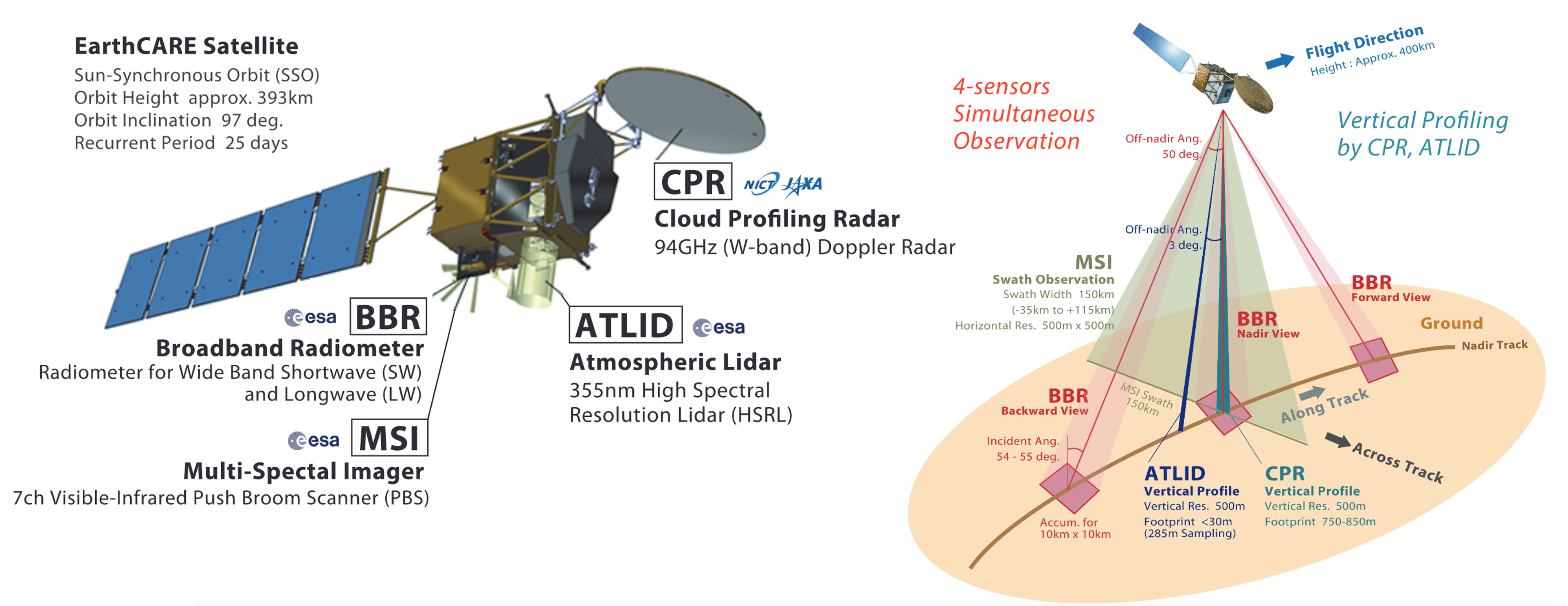
Fig. 8 Overview of EarthCARE’s payload including specification for the four instruments ATLID, CPR, MSI, and BBR (left). Schematic of viewing geometries, footprints and resolutions (right). Figure courtesy of JAXA.#
Cloud profiling radar (CPR)
EarthCARE introduces the first spaceborne cloud profiling radar CPR with Doppler capability to provide measurements of clouds, precipitation, and particle vertical motion. It operates at 94 GHz (W-Band), with a vertical resolution of 100 m and an along-track resolution of 500 m.
Atmospheric lidar (ATLID)
The ATLID is a high-spectral-resolution atmospheric backscatter light detection and ranging (HSRL) instrument operating at 355 nm with depolarization capabilities. It is designed for the detection of cloud boundaries and the profiling of aerosols and optically thin clouds. ATLID provides measurements with a vertical resolution of about 100 m from ground to an altitude of 20 km, and lower vertical resolution at altitudes above 20 km.
Multi-spectral imager (MSI)
The MSI utilizes four solar channels (0.67-2.21 μm) and three thermal channels (8.8-12.0 μm). With a swath width of 150 km and pixel sampling size of 500 m, it provides cloud and aerosol observations extended in the across-track direction.
Broadband radiometer (BBR)
The BBR measures collocated reflected solar and emitted thermal radiation, from which the broadband fluxes at the top of the atmosphere are derived. It is of paramount importance for the attempt at radiative closure, one of the core objectives of EarthCARE. Along track, the BBR’s three telescopes allow for forward, nadir, and backward viewing geometry. While the nominal scene size is 10 km x 10 km, it is configurable to 5 km wide and 21 km long.
Orbit#
EarthCARE is launched into a sun-synchronous orbit at a height of approximately 393 km with a descending-node crossing time of 14:00 mean local solar time. The revisit time is 25 days.
Retrievals#
The four sensors on EarthCARE will provide standalone products and will be utilized for synergy retrievals combining the strengths and different sensitivities of several instruments.